
DSWM Quarterly: Q3 2026
Investing Insights
After double-digit second-quarter gains, U.S. and international equities lost momentum in the third quarter. Rising interest rates, higher energy costs, inflation concerns, and the war in Iran weighed on sentiment, although continued economic growth and solid corporate earnings supported many areas of the market. Fixed income experienced the most significant shift, as Treasury yields rose sharply amid renewed concerns about inflation, monetary policy, fiscal deficits, and government borrowing. Higher yields pressured bond prices but also improved future reinvestment opportunities. Unlike the broad gains of the previous quarter, third-quarter performance varied significantly across asset classes and market segments, reinforcing the value of diversification.
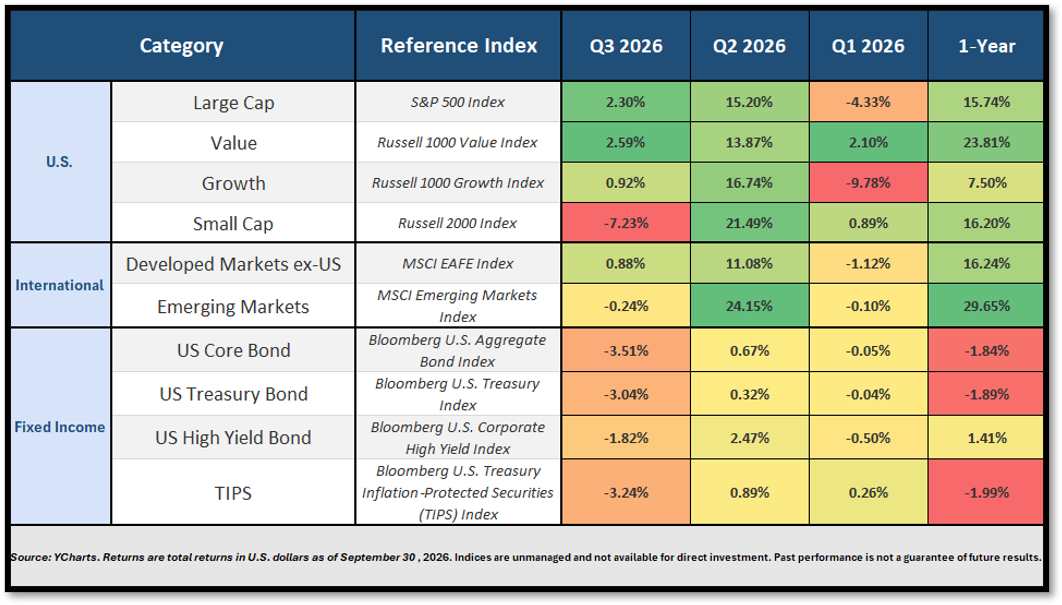 After a mid-August bounce, stocks largely went sideways in the third quarter, as upward momentum from artificial intelligence (AI) related stocks waned and rising interest rates gave investors pause. It is hard to believe it has been over 3 years since the momentum around AI connected stocks really began to accelerate. Since late 2022, AI-linked stocks have grown from roughly 25% of the market value of the S&P 500® to be about 45% currently. So, it should come as no surprise the announcement of safety concerns by AI executives in early September weighed heavily on the U.S. market. This gave way to value stocks outperforming growth for the quarter, with smaller large cap and mid-cap companies leading the way. The S&P 500® still finished in positive territory for the quarter, up 2.3%, bolstered by strong corporate earnings and continued U.S. economic growth.
U.S. small cap equities struggled to maintain the pace from the second quarter, weighed down by concerns of increasing borrowing costs and inflation impact on expenses, the Russell 2000 ended the third quarter down 7.23%. The divergence between U.S. large cap and small cap performance is a notable development during the third quarter. Historically, small cap companies are more impacted by the rate environment since they tend to be more sensitive to financing conditions and borrowing costs to run and grow. The gravity of the change quarter over quarter for small cap U.S. equities relative to large cap U.S. equites is a perfect example of how rapidly markets can change and why diversification is fundamental to long-term investing.
International equity markets posted mixed third-quarter results as strong economic and corporate fundamentals were offset by geopolitical tensions, higher energy prices, and rising interest rates. Developed markets generally outperformed emerging markets, albeit with significant regional variation in performance. In Europe, Eurozone stocks declined after the European Central Bank (ECB) responded to elevated energy costs pushing inflation higher by raising rates in September. The UK market was a bright spot in Europe, supported by the energy and materials sectors which benefited from higher prices. Japanese equities continued to advance with the TOPIX Index adding 3.8% return in the 3rd quarter which puts the index up 20.03% for the year. Similar to the U.S., Japanese equities have been driven by technology-related companies, however the 3rd quarter did see some broadening to value stocks.
Emerging market equities as a whole were slightly down for the quarter. The laggards being the major chip producers, South Korea and Tawain, after a very strong first half of the year increasing competition from China and some concerns surrounding the hyperscalers spending on chips showed in a pullback during the 3rd quarter. India was also laggard, as high energy costs increased the expectation of rate hikes from the Reserve Bank of India (RBI), which could lead to lower growth for the most populated country in the world. Chinese equities benefited as technology and chip makers rallied, however disappointing economic data later in the quarter gave back some of those gains. Stronger commodity prices delivered positive returns to some of the major emerging market energy and resource exporters, in particular Brazil and South Africa.
Bond markets have recently become a central focus for investors in the U.S. and globally. Higher energy costs have intensified inflationary pressure, prompting central banks to raise interest rates or signal that increases may be forthcoming. In September, the Federal Reserve implemented its first rate hike since 2023, increasing its policy rate by a quarter percentage point. The move itself had limited market impact because U.S. Treasury yields had already been rising throughout the year. For perspective on how high rates have climbed, until recently, the 10-year U.S. Treasury yield had not closed above 5% in nearly 19 years. Rising global yields reflect more than inflationary pressure. Concerns about government borrowing and widening fiscal deficits are also leading investors to demand higher returns. The sharp rise in rates weighed heavily on bond prices, particularly longer-duration securities. The Bloomberg U.S. Aggregate Bond Index declined 3.51% during the quarter, its weakest quarterly performance since 2022. Over time, higher rates should benefit investors as maturing bonds and other fixed-income holdings can be reinvested at more attractive yields.
Despite the challenging third quarter, higher yields have improved the outlook for fixed-income returns. Higher starting yields offer more income and a greater cushion against further rate increases. Although inflation, fiscal policy, and monetary policy remain key risks, the bond market’s repricing has created a more attractive entry point for long-term investors.
As we enter the final quarter of 2026, investors continue to face a complex mix of opportunities and risks. The upcoming November 3 U.S. midterm elections introduce another source of uncertainty as investors evaluate how changes in the balance of power could influence fiscal, regulatory, and economic policy. Historically mid-term elections have led to a period of increased volatility, however, political outcomes have been a poor foundation for long-term investment decisions.
The dispersion seen across markets this year also serves as an important reminder of the power of diversification. Leadership has shifted among large- and small-cap stocks, U.S. and international equities, and stocks and bonds as economic and interest-rate expectations have changed. Our view is rather than attempting to predict which asset class, political outcome, or market theme will lead next, maintaining a diversified portfolio is pivotal to achieving long-term goals. Periods of uncertainty are inevitable, but we believe history continues to support a disciplined, diversified, and long-term approach rather than reacting to short-term market movements.