
DSWM Quarterly: Q2 2026
Investing Insights
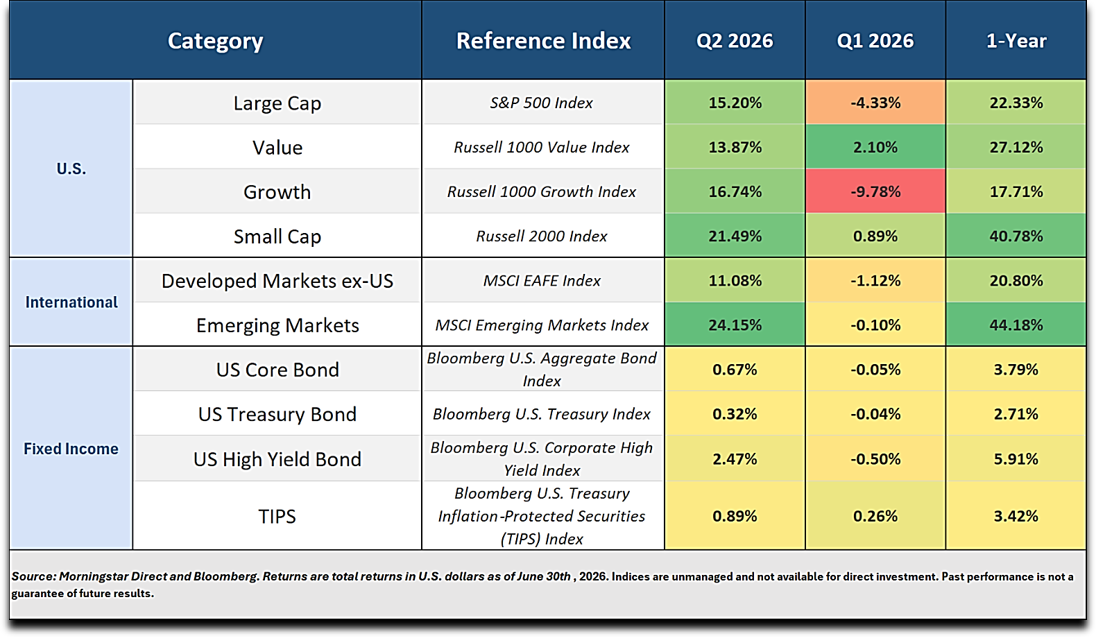 The second quarter was remarkably strong for U.S. equities, with markets overcoming concerns about inflation, interest rates, geopolitical tensions, and elevated valuations. Growth-oriented sectors, particularly artificial intelligence (AI), infrastructure, and semiconductors, led a powerful rally. The S&P 500® finished the quarter up over 15%, with growth stocks leading after what was a dismal first quarter.
After a lackluster first quarter, U.S. small cap equities surged in the second quarter and resumed outpacing U.S. large cap equities. The second quarter marked the Russell 2000 Index’s strongest quarterly performance since 2020. The strongest performers in small caps were in economically sensitive industries, such as regional banks, industrials, and energy-related businesses. Despite the strong gains, some analysts still indicate some short-term risks remain: many small-cap companies will face higher refinancing costs than they enjoyed earlier in the decade, and similar to their large cap counterparts, profitability across the asset class remains uneven.
International equities delivered strong gains during the second quarter of 2026, with several regions outperforming U.S. equities on a relative basis during parts of the quarter. Like the U.S., international stocks benefited from optimism surrounding artificial intelligence (AI)-related investment themes. Equities outside the U.S. continue to see improving investor sentiment and showed an unexpected resiliency to the higher energy costs resulting from the war with Iran. European equities advanced as inflation continued to moderate and corporate earnings maintained strong results. Japanese equities posted another solid quarter, bolstered by continued steps by the Bank of Japan to gradually normalize monetary policy, along with exposure to global technology and semiconductor supply chains. Emerging market equities led all asset classes returning over 24% for the quarter. Within emerging markets, those with significant exposure to semiconductor manufacturing, artificial intelligence infrastructure, and technology exports benefited from accelerating global investment spending.
Fixed income markets were mixed last quarter but in general, positive. Bond markets contended with renewed inflation concerns which were enhanced by higher energy prices tied to the war with Iran and shipping disruptions through the Strait of Hormuz. Despite the developments, the U.S. economy has continued to show resilience through growth and labor stability thus far. The resiliency has led to a shift in market expectations for Federal Reserve’s rate policy, from pricing in rate cuts at the start of the year, to the possibility of rate hikes before the end of the year. Treasury yields moved higher during the quarter, particularly at the front end of the curve, as investors reassessed the likelihood and timing of future rate cuts. Municipal bonds remained an area of relative opportunity for tax-sensitive investors, supported by historically attractive taxable-equivalent yields, resilient credit fundamentals, and favorable long-term technical conditions. For long-term investors, the shift to higher starting yields has provided an added cushion for diversified bond portfolios, allowing income to play a larger role in total return for the entire portfolio.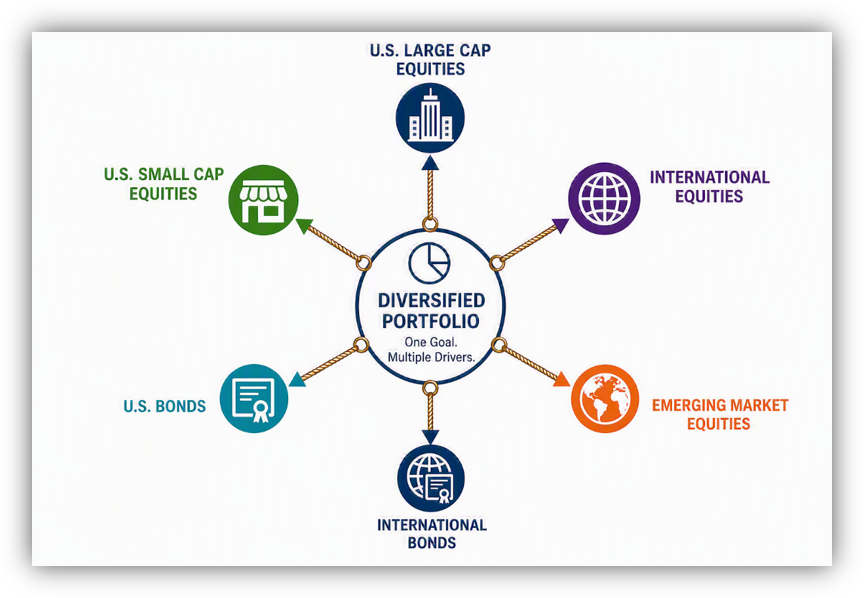
Imagine another tug of war, with multi-faceted teams pulling in different directions – like the spokes on a bicycle wheel and to win, the players must stay centered at the hub of the wheel. The players are U.S. large cap equities, U.S. small cap equities, international large cap equities, emerging market equites, U.S. bonds, and international bonds (for example’s sake we may have even left a few players out). All the players are tugging in their direction and for the “team” to win, we must stay centered. That’s what we try to do for you in structuring your portfolio.
You’ve probably heard someone say they know what they don’t know, well for us, we know that we don’t know which asset class is going to be the leader in any given quarter or other period of measurement. For that reason, we work diligently to build a balanced portfolio that is well diversified across all asset classes with a goal of keeping your investment portfolio centered so that it has the best chance of maintaining the path to your long-term goals.
The second half of the year is no different than any other time in the market, with an endless list of things that can bring volatility, U.S. mid-term elections, fragile geopolitical conditions, a change in optimism for A.I. applications, or a multitude of events. However, when you approach times like these with a well-balanced diversified portfolio, it makes the “tug of war” far less intimidating.